

Bordeaux in Australia in 2026: Great Wines, Softer Prices and a More Selective Market
Bordeaux remains one of the foundations of a serious wine cellar. Few regions offer the same combination of history, longevity after a decade or more in storage.
For Australian collectors in 2026, however, Bordeaux is no longer simply a question of securing the latest highly rated release. The market has changed. Recent vintages have delivered excellent wines, but they have also arrived into a more cautious buying environment, with substantial stock already available and older vintages often presenting a compelling alternative.
That does not reduce the appeal of Bordeaux. In many respects, it makes the region more interesting. For buyers prepared to be selective, the current market offers access to exceptional wines, better pricing and a wider choice between young wines for long-term cellaring and mature or maturing bottles for earlier enjoyment.
A Changed Market for Bordeaux Collectors
The logic of buying Bordeaux has traditionally been relatively straightforward. Purchase leading estates on release, store them correctly, allow the wines to mature and, in many cases, expect values to strengthen over time.
That approach remains valid for certain estates and vintages, but it is no longer automatic. The international fine wine market has softened from the elevated levels reached in previous years. Buyers are more cautious, merchants are carrying significant inventory, and collectors are increasingly comparing new releases with older vintages already available in bottle.
For an Australian buyer, this comparison is particularly relevant. Imported Bordeaux carries more than the original château release price. Currency conversion, freight, duty, GST, insurance and the long-term cost of professional storage all form part of the true cost of ownership.
A newly released wine may be excellent, but if an older, similarly well-regarded vintage is available at the same price or less — already bottled, already aged and closer to drinking maturity — the decision becomes far more nuanced.
In this environment, the strongest collectors are not necessarily those buying the most wine. They are the buyers selecting carefully, purchasing with a clear purpose and storing their wines correctly for the future.
Bordeaux 2022: A Great Vintage with Considerable Availability
There is little doubt that 2022 was an outstanding Bordeaux vintage. Produced in a warm, dry growing season, the best wines combined concentration and richness with impressive freshness, structure and long-term ageing potential.
Across many of the leading estates, the vintage delivered powerful, serious wines that will reward extended cellaring. For Bordeaux enthusiasts, 2022 remains one of the most important recent vintages to consider.
It was also released with considerable confidence and, in many cases, ambitious pricing. High critical scores and the expectation of long-term demand encouraged strong early interest around the world.
Australia received significant allocations of the vintage, including an unusually broad offering through major fine wine merchants. This was positive for consumers: Australian buyers were given access to an exceptional range of Bordeaux 2022 wines, from classified growths through to important Right Bank estates.
As those wines have landed and become more visible in the local market, availability has naturally become part of the pricing conversation. Freshly landed, clearly provenanced stock is now appearing more broadly, including through secondary-market channels. For buyers today, that can create excellent opportunities to acquire high-quality 2022 Bordeaux at more attractive pricing than may have seemed possible when the vintage was first released.
For collectors who purchased early and with a long-term value perspective, the softer pricing environment may be less welcome. A great wine can still be a difficult investment if significant stock remains available at increasingly competitive levels.
The important point is that the quality of Bordeaux 2022 has not changed. The best wines remain deeply impressive and highly age-worthy. What has changed is the market surrounding them. For consumers buying to drink and cellar, carefully selected 2022 Bordeaux may now offer some of the most exciting opportunities in the category.
Bordeaux 2023: A More Classical Vintage Requiring Selection
The 2023 vintage presents a different style of Bordeaux. Where 2022 is associated with concentration and scale, the best 2023 wines are generally more classical in profile: fresher, more aromatic, more restrained and less driven by power.
At the top end, there are some excellent wines. Leading estates produced Bordeaux with elegance, fine tannins and the kind of balanced structure that will appeal to collectors who value finesse and freshness over richness.
For drinkers who enjoy a more traditional style of Bordeaux, carefully chosen 2023 wines may be particularly attractive. The wines can show perfume, precision and approachability without sacrificing the ability to mature gracefully in bottle.
However, 2023 is not a vintage to buy indiscriminately. Quality is less uniform than in 2022. The strongest properties, supported by rigorous vineyard selection and the resources to make difficult decisions, often performed very well. Elsewhere, results can be more variable.
For Australian collectors, 2023 should therefore be viewed as an estate-by-estate vintage. The right wines, purchased at sensible pricing, may become highly enjoyable additions to a cellar. But the vintage does not reward buying simply by classification or reputation alone.
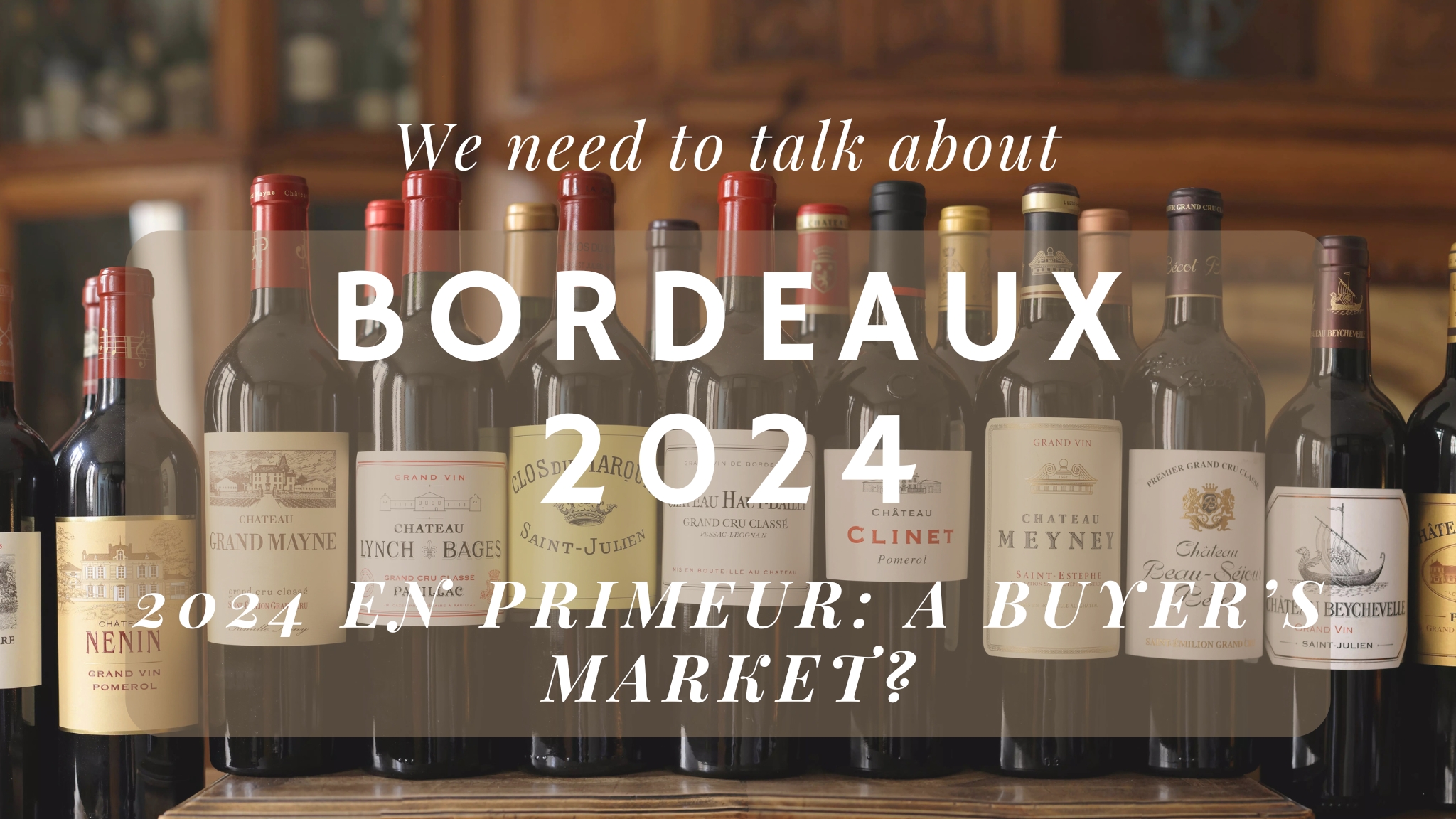
Bordeaux 2024: A Valuable Entry Point into the Great Estates
Bordeaux 2024 arrived at a difficult moment for the region. Growing conditions were challenging, the broader fine wine market remained subdued, and producers faced pressure to reconnect with buyers after several expensive campaigns.
The consequence was more disciplined release pricing, particularly among some of Bordeaux’s most famous estates.
It is important not to overstate the vintage. Bordeaux 2024 is not generally considered a great vintage in the same league as 2016, 2019, 2020 or 2022. Quality is varied, and careful selection remains essential.
Yet several leading estates produced wines of genuine quality, elegance and pedigree. For collectors who have long wanted to buy First Growth Bordeaux but have found pricing increasingly difficult to justify, 2024 offers an unusually accessible route into some of the most famous wines in the world.
At the time of writing, Cellared Fine Wine has listed several important 2024 Bordeaux releases, including:
- Château Lafite Rothschild 2024 — $950
A finely structured, elegant Pauillac from one of Bordeaux’s most revered estates. Lafite’s restraint and precision are particularly well suited to a vintage built around freshness rather than sheer size. - Château Margaux 2024 — $899
Floral, refined and graceful, this is an opportunity to cellar a First Growth with unmistakable Margaux character at a considerably more approachable price than stronger recent vintages. - Château Mouton Rothschild 2024 — $832
A Cabernet-led Pauillac offering First Growth stature, freshness and long-term cellaring potential, without the release pricing attached to the most powerful recent vintages. - Château Angélus 2024 — $595
A significant Saint-Émilion estate showing a more refined and elegant direction, offering prestige and genuine drinking interest. - Château Les Carmes Haut-Brion 2024 — $199
While not a First Growth, Les Carmes Haut-Brion has become one of the most compelling names in contemporary Bordeaux. In 2024, it represents a particularly appealing combination of quality, distinction and relative value.
The attraction of these wines is not that 2024 will necessarily outperform the strongest modern vintages. Rather, it is that they offer genuine access to great estates at pricing more closely aligned with today’s market.
For the collector whose ambition is to eventually open a bottle of Lafite, Margaux or Mouton, rather than simply hold it as a financial asset, the 2024 vintage may prove one of the most sensible entry points of recent years.
Bordeaux 2025 En Primeur: Quality Is Clear, but Value Matters More Than Ever
The current Bordeaux 2025 en primeur campaign brings the market into even sharper focus.
Early critical commentary on the vintage has been highly positive. Despite a challenging season and, in some cases, very low yields, a number of leading estates have produced wines with real concentration, freshness, structure and classical balance.
At the highest level, there are clearly excellent wines in 2025.
The commercial challenge is that these wines are entering a market already offering considerable choice. High-quality 2022 Bordeaux remains available. Selective 2023 wines are still relevant. Well-priced 2024 releases offer access to famous estates. Mature and maturing older vintages can also be found in the market, often with the benefit of greater bottle age and immediate physical availability.
This creates a difficult question for collectors: why commit to a young wine still in barrel, pay for delivery and then fund many years of storage, when an older, similarly well-regarded vintage may already be available at comparable or lower pricing?
That question does not diminish the quality of 2025. It simply reflects the reality of buying fine wine in a softer, more mature market.
The cost of carry is increasingly important. Fine wine does not age for free. A bottle of Bordeaux purchased young may require ten, fifteen or twenty years of appropriate storage before reaching a desirable drinking window. Over that time, storage, insurance and the opportunity cost of capital all contribute to its real cost.
An older vintage offered today may already have absorbed much of that waiting period. Where provenance and condition are excellent, such wines can offer immediate reassurance, earlier enjoyment and, in some cases, better relative value.
There is also a broader change in the way people consume and collect wine. Many buyers are drinking more selectively, holding fewer bottles and placing greater emphasis on wines they genuinely expect to open and enjoy. Prestige remains important, but value and purpose are now equally significant considerations.
For Bordeaux 2025 to be genuinely compelling, pricing will need to reflect this changed environment. The best wines may still deserve a place in serious cellars, particularly where production is limited and the estate has clearly excelled. But buyers are now entitled to compare them directly with back vintages, professionally stored stock and recently released wines already available at attractive prices.
What Should Australian Bordeaux Buyers Do in 2026?
For Australian collectors, the current Bordeaux market is not one to fear. It is one to approach thoughtfully.
The 2022 vintage remains an exceptional source of long-term cellar wines, particularly where prices have softened from original expectations. The 2023 vintage offers a more classical style, but demands careful estate selection. The 2024 vintage provides a rare opportunity to buy into the greatest names of Bordeaux at more approachable pricing. The 2025 vintage may prove excellent, but buyers should be disciplined and compare release pricing against readily available alternatives.
Most importantly, collectors should consider why they are purchasing each wine. Is it intended for drinking in ten years? For a significant birthday or anniversary? For building a balanced cellar? Or with the expectation of future resale?
The best buying decisions will be those matched to a clear purpose, supported by strong provenance and protected by correct storage.
Protecting a Bordeaux Collection in Sydney
Bordeaux is one of the world’s great cellaring wines, but its future quality depends heavily on how it is stored. Temperature fluctuation, heat, poor humidity and insecure conditions can compromise both enjoyment and value over time.
Rushcutters Wine Storage provides secure, climate-controlled wine storage in Sydney’s Eastern Suburbs, conveniently located for collectors in the CBD and surrounding areas. Whether storing newly purchased First Growth Bordeaux, building a long-term cellar or protecting mature wines acquired for future drinking, correct storage is an essential part of ownership.
In a market where buying well matters more than ever, professional storage ensures that the bottles you select today are given every opportunity to reach their full potential in the years ahead.